All upcoming events
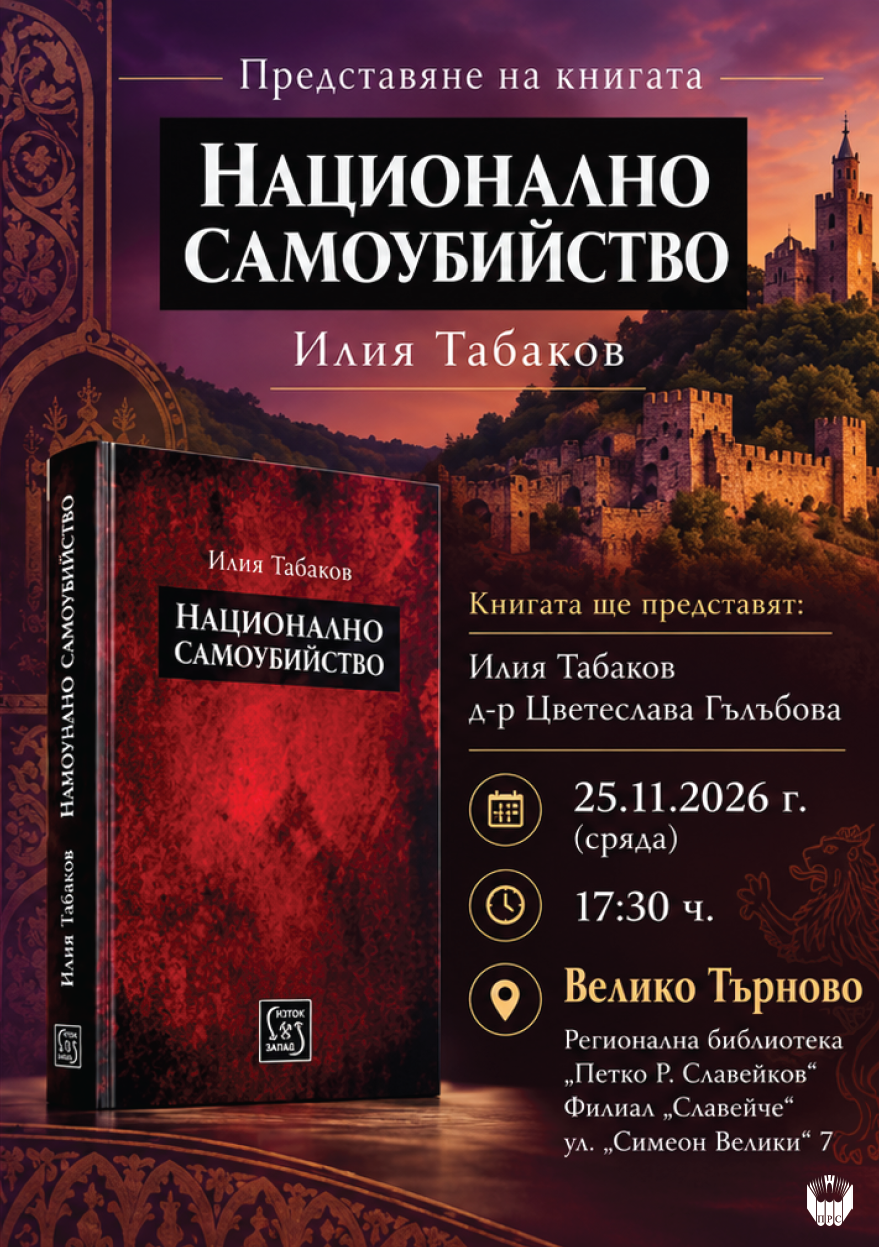
On 25 November, from 5.30 pm, Ilia Tabakov will present his book "National Suicide". Do come along!
About the book:
How does a nation die? Not with a bang, but through an invisible erosion of national identity.
The book is a ruthless dissection of a people who have lost their logos; their inner sense of purpose. It is a disturbing wake-up call that makes us reflect on what sort of Bulgaria we wish to leave to the children who are yet to be born.
It is neither an indictment, nor an apology, nor an expression of nostalgia. It is a structured attempt to understand a complex and often unrecognisable transformation, in which a nation is gradually losing its fundamental pillars: its identity, memory, demographic structure, institutional autonomy and strategy for the future.
‘National suicide’ is not a pessimistic prediction, but an attempt at intellectual mobilisation. History does not forgive nations that have lost their will to find meaning, but it leaves the door ajar for those who are prepared to defend their right to exist. Those who will remain, not because they believe, but because they refuse to give up. For those who will not leave their country, not even in their thoughts. Who will not replace their language with a foreign syntax, or their children with apps; who refuse to let the army be replaced by algorithms. Who will not surrender their past in exchange for a future programmed by others.
“National suicide is not a matter of fate, but a choice,” concludes Tabakov, leaving the reader with the difficult task of deciding whether they wish to uphold their Bulgarian identity.
About the author:
Iliya Tabakov is a sociologist and holds a PhD in national security; he completed his higher education in the field of social sciences and security, specialising academically and in his research on the interaction between social processes, technology and strategic management.
He is a lecturer at the Military Academy, where he teaches courses on national security and the impact of new technologies, including artificial intelligence, on the contemporary security environment. His research interests encompass the sociology of degradation, the theory of war, geopolitics and geostrategy, social engineering, cognitive security and the transformations of statehood in an environment of accelerating technological change.
In his research, he integrates classical sociological and philosophical concepts with an analysis of social dynamics, technological progress and national security, as well as the long-term risks to statehood associated with processes of social disintegration, demographic transformations and the erosion of institutional resilience.